
Best Portable Power Station 2026: Picks by Job
This guide identifies the best portable power station for specific use cases, from small DC charging to whole-home backup. It compares capacity, output, and features of models like Anker SOLIX C1000 Gen 2 and EcoFlow DELTA Pro 3.
Short answer: The best portable power station is the one sized for your job. For phones, laptops and other USB-C or 12V gear, the Anker SOLIX C300 DC is enough. For camping and short outages, look at about 1kWh: the Anker SOLIX C1000 Gen 2, the DJI Power 1000 V2 for higher output, or the lighter Jackery Explorer 1000 v2. To keep a fridge and a few essentials running, step up to about 2kWh: the Anker SOLIX C2000 Gen 2 if you may add a battery later, the Jackery Explorer 2000 v2 or the EcoFlow DELTA 3 Max. For expandable home backup with 240V, the EcoFlow DELTA Pro 3.
VoltLore earns a commission from qualifying purchases made through links marked “Paid link”, at no extra cost to you. As an Amazon Associate, VoltLore earns from qualifying purchases.
Images in this story
Image 1 of 1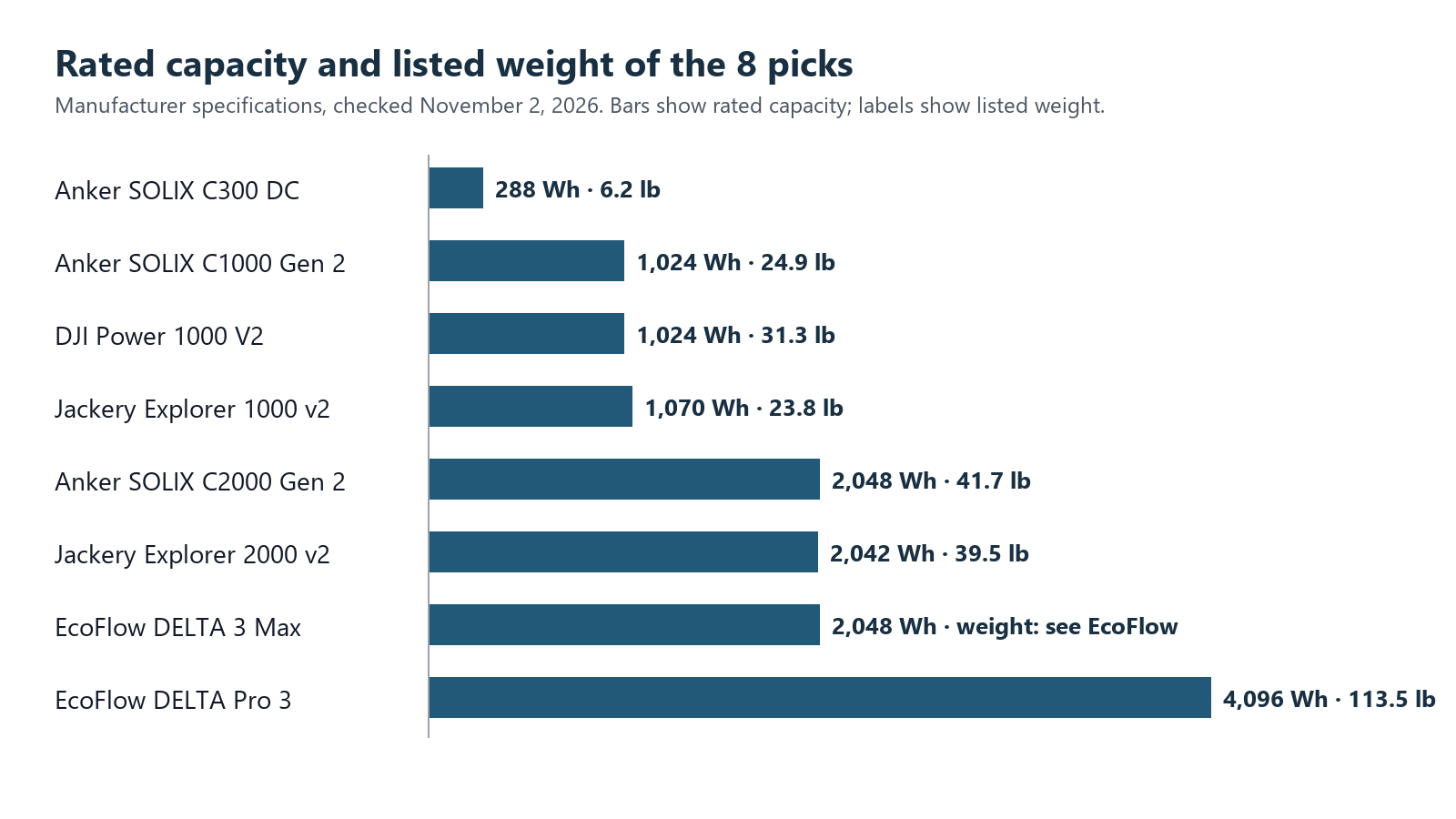
On this page
Short answer: The best portable power station is the one sized for your job. For phones, laptops and other USB-C or 12V gear, the Anker SOLIX C300 DC is enough. For camping and short outages, look at about 1kWh: the Anker SOLIX C1000 Gen 2, the DJI Power 1000 V2 for higher output, or the lighter Jackery Explorer 1000 v2. To keep a fridge and a few essentials running, step up to about 2kWh: the Anker SOLIX C2000 Gen 2 if you may add a battery later, the Jackery Explorer 2000 v2 or the EcoFlow DELTA 3 Max. For expandable home backup with 240V, the EcoFlow DELTA Pro 3.

Our top picks
- Best for DC-only gearAnker SOLIX C300 DCSee on AmazonPaid link
- Best balanced 1kWh pickAnker SOLIX C1000 Gen 2See on AmazonPaid link
- Highest output at 1kWhDJI Power 1000 V2See on AmazonPaid link
- Lightest 1kWh pickJackery Explorer 1000 v2See on AmazonPaid link
- Best 2kWh pick if you may expandAnker SOLIX C2000 Gen 2See on AmazonPaid link
- 2kWh with 2,200W outputJackery Explorer 2000 v2See on AmazonPaid link
- 2,048Wh with 2,400W outputEcoFlow DELTA 3 MaxSee on AmazonPaid link
- Best for expandable home backupEcoFlow DELTA Pro 3 Portable Power StationSee on AmazonPaid link
The chart shows the trade-off this guide is built on: every step up in stored energy adds weight. The 2kWh picks weigh around 40lb, and the DELTA Pro 3 is close to three times that.
How we picked
We started from the models VoltLore has already analysed from manufacturer documentation, then applied the same four steps to each one.
- Available now. We kept only models we could open as in-stock listings on Amazon US on November 2, 2026. The BLUETTI AC50P was unavailable and the BLUETTI Elite 100 V2 was a pre-order, so both are left out for now.
- Grouped by job. We sorted the rest into four capacity tiers that match common jobs: DC-only charging, about 1kWh, about 2kWh, and 4kWh and up.
- Compared on the same four specifications. Within each tier we compared continuous AC output, maximum solar input, listed weight and whether an expansion battery is supported, all from the makers' US pages and manuals.
- One reason to choose, one reason to skip. A model made the list only if it leads its tier on at least one of those four points, and we name its main drawback next to it.
We did not test these units ourselves. Usable energy, noise and real charging speed vary with load, temperature and settings, so treat every figure as a manufacturer rating.
How to choose
Four numbers decide most purchases. Check them in this order.
- Stored energy (Wh) decides how long. The rated capacity is what the battery holds, not what reaches your devices. Inverter and standby losses mean AC loads get less; plan on roughly 80% of the rating as a working figure, and less in the cold. Our sizing guide shows how to total your loads.
- Continuous AC output (W) decides what can run at once. It must exceed the combined running watts of everything plugged in. Surge or peak figures only cover a brief start-up spike, such as a fridge compressor.
- Recharge decides the next day. Compare the maximum solar input and the wall recharge time, and check the solar connector and voltage range in the manual before buying panels.
- Weight and expansion decide whether it fits your life. A 40lb unit is fine on a shelf and tiring on stairs. If your needs may grow, buy a model that accepts an expansion battery now; a fixed-capacity unit cannot be upgraded later.
All picks use LiFePO4 (LFP) batteries. Cycle-life figures are manufacturer ratings, not lifespans we measured.
Which one fits you
| If you are… | Start with | Why | Watch out for |
|---|---|---|---|
| Keeping phones, laptops and a router charged in a short outage | Anker SOLIX C300 DC | All-USB-C and 12V, 6.2lb | No AC outlet for anything with a wall plug |
| Car camping or tailgating with AC gear | Jackery Explorer 1000 v2 | Lightest 1kWh pick at 23.8lb, 12V socket | 1,500W limit; check kettles and hair dryers |
| Running higher-wattage tools for short periods | DJI Power 1000 V2 | 2,600W, highest in its tier | Heaviest 1kWh pick at 31.3lb |
| Covering a CPAP, router and lights overnight, with solar | Anker SOLIX C1000 Gen 2 | 2,000W and up to 600W solar at 24.9lb | Capacity cannot be expanded |
| Keeping a fridge and essentials going and maybe expanding later | Anker SOLIX C2000 Gen 2 | 2,048Wh, 800W solar, BP2000 Gen 2 battery | 41.7lb; 120V only |
| Wanting a 2kWh unit that stays put and plugs in simply | Jackery Explorer 2000 v2 | 2,042Wh, 2,200W, three AC outlets | Fixed battery, 400W solar ceiling |
| Pairing a 2kWh unit with a modest solar array | EcoFlow DELTA 3 Max | 2,048Wh, 2,400W, 500W solar | Do not mix up specs with the Max Plus |
| Backing up 240V circuits or planning multi-day backup | EcoFlow DELTA Pro 3 | 4,096Wh, 120V/240V, up to 48kWh | 113.5lb; wiring work needs an electrician |
Recommendations by situation
| Model | Rated capacity | Continuous AC output | Max solar input | Listed weight | Expansion battery |
|---|---|---|---|---|---|
| Anker SOLIX C300 DC See on Amazon (Paid link) |
288Wh | No AC outlets (300W total DC/USB) | 100W | 2.8kg (6.2lb) | No |
| Anker SOLIX C1000 Gen 2 See on Amazon (Paid link) |
1,024Wh | 2,000W | 600W | 24.9lb | No |
| DJI Power 1000 V2 See on Amazon (Paid link) |
1,024Wh | 2,600W | Check DJI manual | 14.2kg (31.3lb) | Check DJI accessories |
| Jackery Explorer 1000 v2 See on Amazon (Paid link) |
1,070Wh | 1,500W | Check Jackery manual | 10.8kg (23.8lb) | No |
| Anker SOLIX C2000 Gen 2 See on Amazon (Paid link) |
2,048Wh | 2,400W | 800W | 41.7lb | Yes (BP2000 Gen 2) |
| Jackery Explorer 2000 v2 See on Amazon (Paid link) |
2,042Wh | 2,200W | 400W (2 × 200W) | 39.5lb | No |
| EcoFlow DELTA 3 Max See on Amazon (Paid link) |
2,048Wh | 2,400W | 500W | Check EcoFlow listing | Check EcoFlow listing |
| EcoFlow DELTA Pro 3 See on Amazon (Paid link) |
4,096Wh | 4,000W, 120V/240V | 2,600W combined | 113.5lb | Yes, up to 48kWh |
Figures are from each manufacturer's US specifications and manuals, checked November 2, 2026.
Small DC-only kit: Anker SOLIX C300 DC
Choose it when everything you power charges from USB-C, USB-A or a 12V car socket: phones, laptops, a router with a DC cable, camera batteries.
- Good: 288Wh in a 6.2lb unit; two 140W USB-C ports that also recharge it from a suitable PD charger; 12V car socket.
- Limit: no AC outlets, and all ports share a 300W total ceiling. Solar input tops out at 100W.
Read our C300 DC analysis for the port-by-port limits.
See on Amazon (Paid link)
About 1kWh for camping and short outages
Anker SOLIX C1000 Gen 2 is the balanced pick.
- Good: 2,000W of AC output and up to 600W of solar in a 24.9lb unit; the maker rates it for 4,000 cycles to 80% capacity.
- Limit: it does not accept an expansion battery, so buy it only if about 1kWh will stay enough.
See our C1000 Gen 2 analysis.
DJI Power 1000 V2 is the output pick.
- Good: the highest continuous output in this tier, 2,600W, and two 140W USB-C ports; DJI rates it for over 80% capacity after 4,000 cycles.
- Limit: at about 31.3lb it is the heaviest of the three, and you need DJI's manual for solar and accessory details.
Jackery Explorer 1000 v2 is the carry pick.
- Good: about 23.8lb for 1,070Wh, with a built-in 12V socket for car accessories.
- Limit: its 1,500W rating is the lowest here; check your largest appliance before choosing it.
Our DJI vs Jackery comparison covers that trade-off in detail.
See on Amazon (Paid link)
About 2kWh for a fridge plus essentials
Anker SOLIX C2000 Gen 2 is the pick if your plan may grow.
- Good: 2,048Wh and 2,400W, up to 800W of solar, and a BP2000 Gen 2 expansion battery when you need more.
- Limit: 41.7lb, and 120V output only; its 4,000W peak is a start-up allowance, not a continuous rating.
See our C2000 Gen 2 analysis.
Jackery Explorer 2000 v2 is the simple stay-put pick.
- Good: 2,042Wh and 2,200W of output with three 120V outlets, at 39.5lb.
- Limit: a fixed battery and a 400W solar ceiling (200W per input).
Read our Explorer 2000 v2 analysis.
EcoFlow DELTA 3 Max is the solar-matched pick.
- Good: 2,048Wh and 2,400W, with 500W of solar on the standard US model.
- Limit: the solar ceiling is lower than the C2000 Gen 2's, and the DELTA 3 Max Plus has different output and solar figures, so check which one a listing shows.
Our DELTA 3 Max solar analysis explains the solar limits.
Whether a 2kWh station can carry a fridge through an outage depends on the fridge. Our refrigerator sizing guide walks through the numbers.
See on Amazon (Paid link)
4kWh and up for expandable home backup: EcoFlow DELTA Pro 3
Choose it when measured essentials need about 4kWh, you want 240V output, or you plan to add batteries toward a larger system.
- Good: 4,096Wh, 4,000W at 120V or 240V, up to 2,600W of combined solar input, and expansion up to 48kWh.
- Limit: about 113.5lb, so plan where it lives and how it moves. Connecting it to home circuits is a job for a licensed electrician.
Our DELTA Pro 3 analysis covers the output modes, and our multi-day backup guide covers recharging between days.
See on Amazon (Paid link)
Why these picks and their downsides
| Model | Why it made the list | Skip it if |
|---|---|---|
| Anker SOLIX C300 DC | Small, light, fast USB-C recharge | You need any AC outlet |
| Anker SOLIX C1000 Gen 2 | 2,000W and 600W solar at 24.9lb | You may want an expansion battery |
| DJI Power 1000 V2 | Highest output in the 1kWh group | Weight matters most |
| Jackery Explorer 1000 v2 | Lightest 1kWh pick | A load needs more than 1,500W |
| Anker SOLIX C2000 Gen 2 | 2kWh with an expansion path | You must carry it often |
| Jackery Explorer 2000 v2 | 2kWh with 2,200W output | You want solar above 400W or more capacity later |
| EcoFlow DELTA 3 Max | 2,048Wh with 2,400W output | You need more than 500W of solar on the standard model |
| EcoFlow DELTA Pro 3 | 4kWh, 240V and up to 48kWh | You need to move it regularly |
Cost per usable kWh and battery life
There is no subscription to run these units; the cost is the purchase. To compare value fairly, divide the current price on each product page by the rated capacity in watt-hours, then by about 0.8 for usable energy. Prices change often, so do this with the prices you see when you buy.
Battery life is quoted by manufacturers as cycles to a remaining capacity, for example 4,000 cycles to 80% for the DJI Power 1000 V2 and the Anker SOLIX C1000 Gen 2, and 4,000 cycles to at least 70% for the Jackery Explorer 1000 v2. Treat these as ratings under test conditions, not a promise for your use.
Before you buy
- Find the starting watts of your largest appliance and compare them with the surge rating, and the running watts with the continuous rating.
- Check the outlet types you need: standard 120V outlets, a TT-30 or L14-30 for an RV or transfer switch, USB-C wattage for laptops.
- Match solar panels to the exact input limits and connector in the manual, not just the brand.
- Read the ventilation, operating temperature and storage instructions for the model.
- Note the warranty length and what it covers.
FAQ
Can a portable power station run a CPAP?
Usually yes, if the station's output and outlet type suit the machine. Check your CPAP's power use with humidifier and heated tube settings, and follow the CPAP maker's guidance on battery use. A DC adapter can extend runtime compared with running the AC adapter.
How fast can solar recharge these units?
Only as fast as the maximum solar input allows, and only in strong sun. A unit rated for 500W of solar will not take more, even with larger panels. The input voltage and current limits in the manual also matter.
Can I use one indoors?
These units produce no exhaust, unlike gas generators. Follow the manufacturer's ventilation and temperature instructions, keep vents clear, and do not use one as a substitute for professionally installed home wiring.
Can I fly with a portable power station?
Most cannot go on a plane. FAA rules limit lithium-ion batteries in carry-on bags to 100Wh without approval and 160Wh with airline approval, and every pick here is above that. Check with your airline.
How we researched
This guide compares manufacturer specifications and manuals from Anker SOLIX, DJI, Jackery and EcoFlow, checked on November 2, 2026, together with the detailed analyses linked above. We did not test these units ourselves. Availability was checked on Amazon US the same day.
Sources
- Anker SOLIX C1000 Gen 2 specifications
- Anker SOLIX C2000 Gen 2 specifications
- Anker SOLIX C300 DC specifications
- DJI Power 1000 V2 specifications
- Jackery Explorer 1000 v2 basic information
- Jackery Explorer 2000 v2 specifications
- EcoFlow DELTA 3 Max user manual
- EcoFlow DELTA Pro 3 specifications
- FAA: lithium batteries in baggage
More from VoltLore
Portable Power Station for a Refrigerator: Size and Runtime
Check refrigerator startup demand and daily energy use, then compare four power stations by capacity, weight, charging limits and the backup plan they require.
Portable Power Station for Camping: DJI 1000 V2 vs Jackery 1000 v2
This comparison distinguishes the DJI Power 1000 V2's high continuous AC output from the Jackery Explorer 1000 v2's lighter carrying weight. It clarifies that capacity in watt-hours differs from power in watts, helping campers match devices to the correct unit.
Portable power station for home backup: plan for days
Size a backup battery around essential loads and a realistic recharge plan, then compare a compact and an expandable station by their listed specifications.