
Portable Power Station for Refrigerator: Sizing, Runtime & Safety
Selecting the right portable power station for a refrigerator requires matching battery capacity to daily energy consumption and ensuring inverter surge ratings exceed compressor startup watts. This guide explains how to calculate runtime using EnergyGuide data, compares top models like Anker, BLUETTI, Jackery, and EcoFlow, and outlines critical safety protocols for food preservation during outages.
Quick answer: A portable power station for refrigerator backup needs two things: AC output that covers your fridge's running watts with room for the compressor's start-up draw, and enough battery to cover your outage. Anker says its 2,048Wh SOLIX C2000 Gen 2 runs a dual-door fridge for up to 32 hours. To estimate your own fridge, divide the station's capacity by your fridge's average watts (method below). Keep the fridge door shut: FDA says an unopened refrigerator keeps food cold for about 4 hours on its own.
VoltLore earns a commission from qualifying purchases made through links marked “Paid link”, at no extra cost to you. As an Amazon Associate, VoltLore earns from qualifying purchases.
Images in this story
Image 1 of 1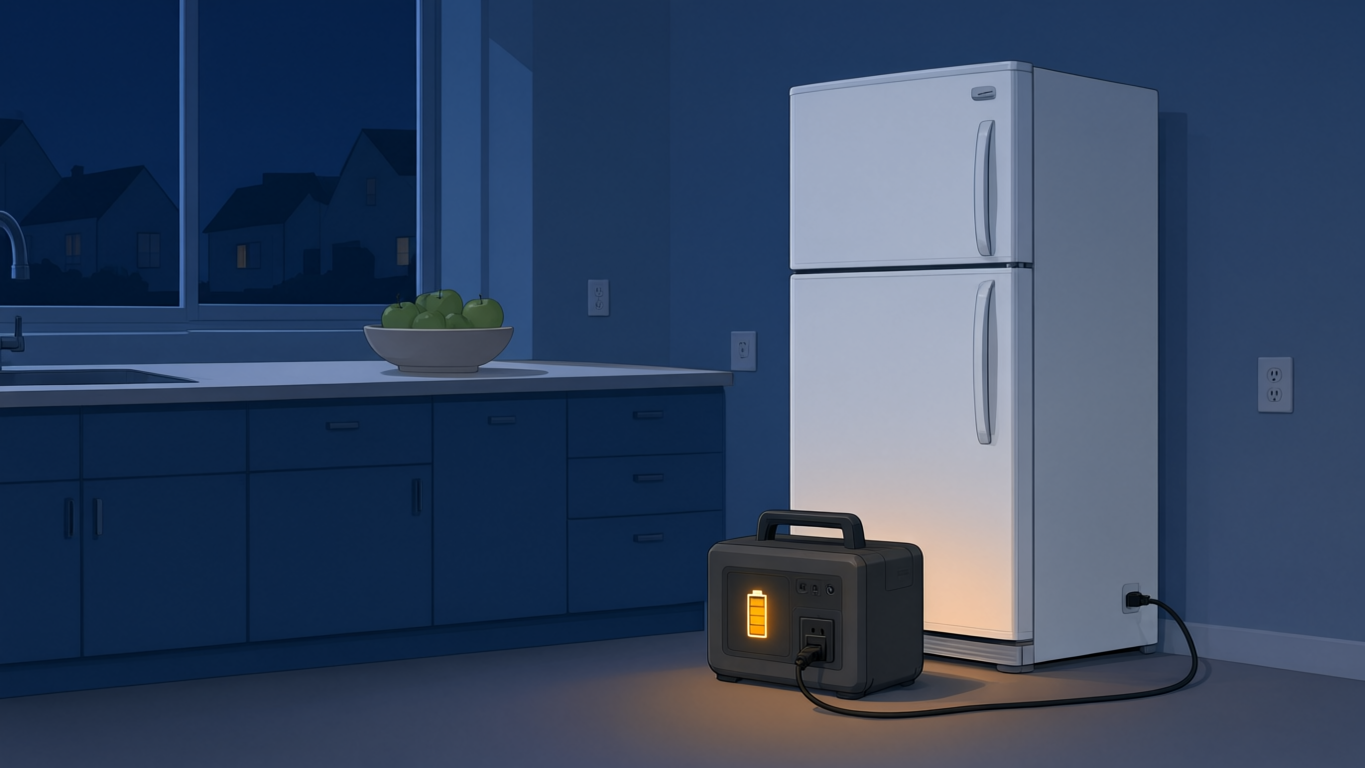
On this page
Quick answer: A portable power station for refrigerator backup needs two things: AC output that covers your fridge's running watts with room for the compressor's start-up draw, and enough battery to cover your outage. Anker says its 2,048Wh SOLIX C2000 Gen 2 runs a dual-door fridge for up to 32 hours. To estimate your own fridge, divide the station's capacity by your fridge's average watts (method below). Keep the fridge door shut: FDA says an unopened refrigerator keeps food cold for about 4 hours on its own.

Our top picks
- Best for Extended OutagesAnker SOLIX C2000 Gen 2Homes that want the longest fridge backup from one unit. Anker states it runs a dual-door fridge for up to 32 hours, and up to 64 hours with the…See the 2,048Wh / 2,400W on AmazonPaid link
- Best for Portability and Short OutagesBLUETTI Elite 100 V2Smaller fridges and shorter outages where weight matters. At 25 lbs it is the lightest pick here, with 1,024Wh and 1,800W output. It accepts up to…See on AmazonPaid link
- Best for Proven LiFePO4 DurabilityJackery Explorer 2000 V2Buyers who want a 2kWh unit with a stated long battery life. Jackery rates the 2,042Wh LiFePO4 pack at 4,000 cycles to 70% or more. AC recharge takes…See the 2,042Wh / 2,200W on AmazonPaid link
- Best for Solar Integration and Grid BackupEcoFlow DELTA 3 MaxOwners who want to leave the fridge plugged into the station while it sits on the grid. EcoFlow's manual describes a Device Backup mode in which the…See the 2,048Wh / 2,400W on AmazonPaid link
Illustration: Keep your food cold with the right backup power solution.
How to Choose: Wattage, Capacity, and Start-Up Draw
You need to match three numbers: the station's continuous AC output, its peak or surge output, and its battery capacity in watt-hours (Wh).
Average watts, not label watts. A fridge does not draw its rated wattage all day. Virginia Cooperative Extension notes that refrigerators "cycle on and off as needed to maintain interior temperatures" and suggests dividing the plugged-in time by three to estimate how long the compressor actually runs. An easier route is the yellow EnergyGuide label: average watts = annual kWh × 1,000 ÷ 8,760 hours. For example, a fridge labeled 600 kWh per year averages about 68 W.
Start-up draw. The same Extension guide says a motor draws about three times more current when starting than when running smoothly. That is why the peak rating matters, not just the continuous rating.
Runtime estimate. Hours ≈ battery Wh ÷ (fridge average watts + the station's own idle draw). Inverter losses are not included, so treat the answer as an upper limit. EIA's definition applies here: one kilowatt equals 1,000 watts, and a kilowatt-hour is 1,000 watts used for one hour.
Recommendations by Situation
| Model (maker spec) | Battery | Continuous AC output | Peak output listed | Weight | Grid backup switching |
|---|---|---|---|---|---|
| Anker SOLIX C2000 Gen 2 See the 2,048Wh / 2,400W on Amazon (Paid link) |
2,048Wh, expandable to 4kWh | 2,400W | 4,000W peak | 41.7 lb | Not stated on the product page |
| BLUETTI Elite 100 V2 See on Amazon (Paid link) |
1,024Wh LiFePO4 | 1,800W | 2,700W "Lifting Power" (no separate surge figure) | 25 lbs | 10 ms UPS |
| Jackery Explorer 2000 V2 See the 2,042Wh / 2,200W on Amazon (Paid link) |
2,042Wh LiFePO4 | 2,200W total (3 AC ports) | 4,400W maximum instantaneous | Around 17.9 kg (about 39.5 lb) | UPS within 20 ms (not 0 ms) |
| EcoFlow DELTA 3 Max See the 2,048Wh / 2,400W on Amazon (Paid link) |
2,048Wh LiFePO4 | 2,400W total (US) | Not listed in the manual; uses X-Boost | Approx. 20.3 kg (44.8 lbs) | Device Backup through a bypass circuit |
Anker SOLIX C2000 Gen 2: Best for Extended Outages
Who it's for: Homes that want the longest fridge backup from one unit. Anker states it runs a dual-door fridge for up to 32 hours, and up to 64 hours with the BP2000 (Gen 2) expansion battery, which takes capacity to 4kWh. Anker lists only 9W of idle power consumption, which matters over a long outage. It recharges to 80% in 45 minutes and 100% in 58 minutes using AC plus solar.
See the 2,048Wh / 2,400W on Amazon (Paid link)
BLUETTI Elite 100 V2: Best for Portability and Short Outages
Who it's for: Smaller fridges and shorter outages where weight matters. At 25 lbs it is the lightest pick here, with 1,024Wh and 1,800W output. It accepts up to 1,000W of solar (full charge in 70 minutes, per BLUETTI) and reaches 80% in 45 minutes on 1,200W AC. With half the capacity of the others, expect roughly half the runtime on the same fridge. BLUETTI's US page listed it as shipping from November 12 when we checked, so confirm availability.
See on Amazon (Paid link)
Jackery Explorer 2000 V2: Best for Proven LiFePO4 Durability
Who it's for: Buyers who want a 2kWh unit with a stated long battery life. Jackery rates the 2,042Wh LiFePO4 pack at 4,000 cycles to 70% or more. AC recharge takes around 2 hours. It supports pass-through use, but AC output is capped at 1,500W while it charges. Standby draw is 18W, the highest listed here, and it does not support expansion battery packs.
See the 2,042Wh / 2,200W on Amazon (Paid link)
EcoFlow DELTA 3 Max: Best for Solar Integration and Grid Backup
Who it's for: Owners who want to leave the fridge plugged into the station while it sits on the grid. EcoFlow's manual describes a Device Backup mode in which the station discharges through a bypass circuit when connected to the grid. Solar input is up to 500W. The manual lists 2,048Wh and 2,400W total AC output in the US version.
See the 2,048Wh / 2,400W on Amazon (Paid link)
Why These Picks and Their Downsides
Here is how the four compare on the same example fridge (68 W average, from the EnergyGuide example above), before inverter losses:
| Model | Battery | Listed idle or standby draw | Upper-limit runtime |
|---|---|---|---|
| Anker SOLIX C2000 Gen 2 | 2,048Wh | 9W | 2,048 ÷ (68 + 9) ≈ 26.6 h |
| Jackery Explorer 2000 V2 | 2,042Wh | 18W | 2,042 ÷ (68 + 18) ≈ 23.7 h |
| EcoFlow DELTA 3 Max | 2,048Wh | Not listed | Below 2,048 ÷ 68 ≈ 30 h |
| BLUETTI Elite 100 V2 | 1,024Wh | Not listed | Below 1,024 ÷ 68 ≈ 15 h |
The Anker has a stated expansion path through the BP2000 battery, but at 41.7 lb it is heavy. The BLUETTI is easy to carry but half the capacity. The Jackery charges from solar more slowly: its two DC ports accept 400W combined. The EcoFlow is the heaviest at 44.8 lbs, and its manual gives no surge figure, so check your fridge's start-up draw against its 2,400W rating before you rely on X-Boost.
Yearly Running Costs and How We Counted
The makers' pages we checked list no paid subscription and no part you must replace each year, so the main running cost is the electricity used to recharge.
Formula: yearly cost = kWh recharged per year × your electricity rate. One full recharge of a 2,048Wh unit is about 2 kWh, plus charging losses.
| Product | Consumable or part | Replacement interval | Units per year | Free or paid features |
|---|---|---|---|---|
| All four picks | None listed by the makers | Not applicable | 0 | Charging and app control need no subscription on the pages we checked |
Prices change often, so check the current price on the product page before you buy.
Before You Buy: Critical Safety and Setup Checks
- Find your fridge's wattage and start-up draw. Check the nameplate or manual. Expect the start-up draw to be several times the running draw.
- Estimate average watts. Use the EnergyGuide method above, or divide the plugged-in time by three as Virginia Cooperative Extension suggests.
- Keep the station dry. Jackery says the Explorer 2000 V2 is not waterproof or dustproof, and EcoFlow rates the DELTA 3 Max at IP20.
- Follow FDA food rules. FDA says an unopened refrigerator keeps food cold for about 4 hours. Discard refrigerated perishable food such as meat, poultry, seafood, milk, eggs or leftovers that has been above 40°F for 4 hours or more.
- Plug the fridge into the station. Never connect a portable power station to a wall outlet to feed power back into your home's wiring. Use a transfer switch installed by a licensed electrician if you want to power home circuits.
FAQ
How long will a portable power station run a fridge?
Divide the station's capacity in Wh by your fridge's average watts plus the station's idle draw. Anker states up to 32 hours for a dual-door fridge on the 2,048Wh SOLIX C2000 Gen 2. A 1,024Wh unit such as the BLUETTI Elite 100 V2 will run the same fridge for roughly half as long.
What is the difference between refrigerator startup watts vs running watts?
Running watts are what the compressor draws once it is going. Start-up watts are the short spike when it kicks on. Virginia Cooperative Extension says a motor draws about three times more current when starting. Your station's peak rating needs to cover that spike.
Can I charge the power station while it runs the fridge?
Jackery says the Explorer 2000 V2 supports pass-through charging, with AC output limited to 1,500W while charging. EcoFlow's DELTA 3 Max can run loads through its bypass circuit while connected to the grid. Check the manual for the model you buy.
Is it safe to leave a portable power station outside in the rain?
No. Jackery says the Explorer 2000 V2 has no waterproof or dustproof rating, and EcoFlow rates the DELTA 3 Max at IP20, which does not cover water. Keep it indoors or under cover.
How We Researched
We compared the makers' own product pages, FAQ pages and manuals for the Anker SOLIX C2000 Gen 2, BLUETTI Elite 100 V2, Jackery Explorer 2000 V2 and EcoFlow DELTA 3 Max. Food safety rules come from FDA. The method for estimating a fridge's real energy use comes from Virginia Cooperative Extension, and electricity units from the U.S. Energy Information Administration.
We did not test these units ourselves. Runtime claims such as "up to 32 hours" are the makers' figures. The runtime table is our own arithmetic on an example fridge and does not include inverter losses. We left out units under 1,000Wh because they give too little runtime for a full-size fridge over a day-long outage.
Sources
- Anker SOLIX C2000 Gen 2 Portable Power Station - 2,048Wh | 2,400W - Anker SOLIX US
- BLUETTI Elite 100 V2 Portable Power Station | 1,800W 1,024Wh - BLUETTI US
- Food and Water Safety During Power Outages and Floods | FDA
- ENERGY SERIES: Estimating Appliance and Home Electronic Energy Use | VCE Publications | Virginia Tech
- Measuring electricity - U.S. Energy Information Administration (EIA)
- Jackery Explorer 2000 V2 Basic Information
- EcoFlow DELTA 3 Max user manual
More from VoltLore
Portable Power Station for Camping: DJI 1000 V2 vs Jackery 1000 v2
This comparison distinguishes the DJI Power 1000 V2's high continuous AC output from the Jackery Explorer 1000 v2's lighter carrying weight. It clarifies that capacity in watt-hours differs from power in watts, helping campers match devices to the correct unit.
Portable power station for home backup: plan for days
Size a backup battery around essential loads and a realistic recharge plan, then compare a compact and an expandable station by their listed specifications.
Anker SOLIX C1000 portable power station: Gen 2 backup
Anker SOLIX C1000 portable power station, Gen 2: assess 1,024Wh capacity, 2,000W output, carrying weight and expansion limits for essential backup.