
EcoFlow DELTA Pro 3: Build an Essentials Backup Plan Before Buying
Plan the DELTA Pro 3 around essential loads: 4,096Wh capacity, AC operating modes, a 115 lb transport route, recharge and qualified home integration.
As an Amazon Associate I earn from qualifying purchases.
Images in this story
Image 1 of 5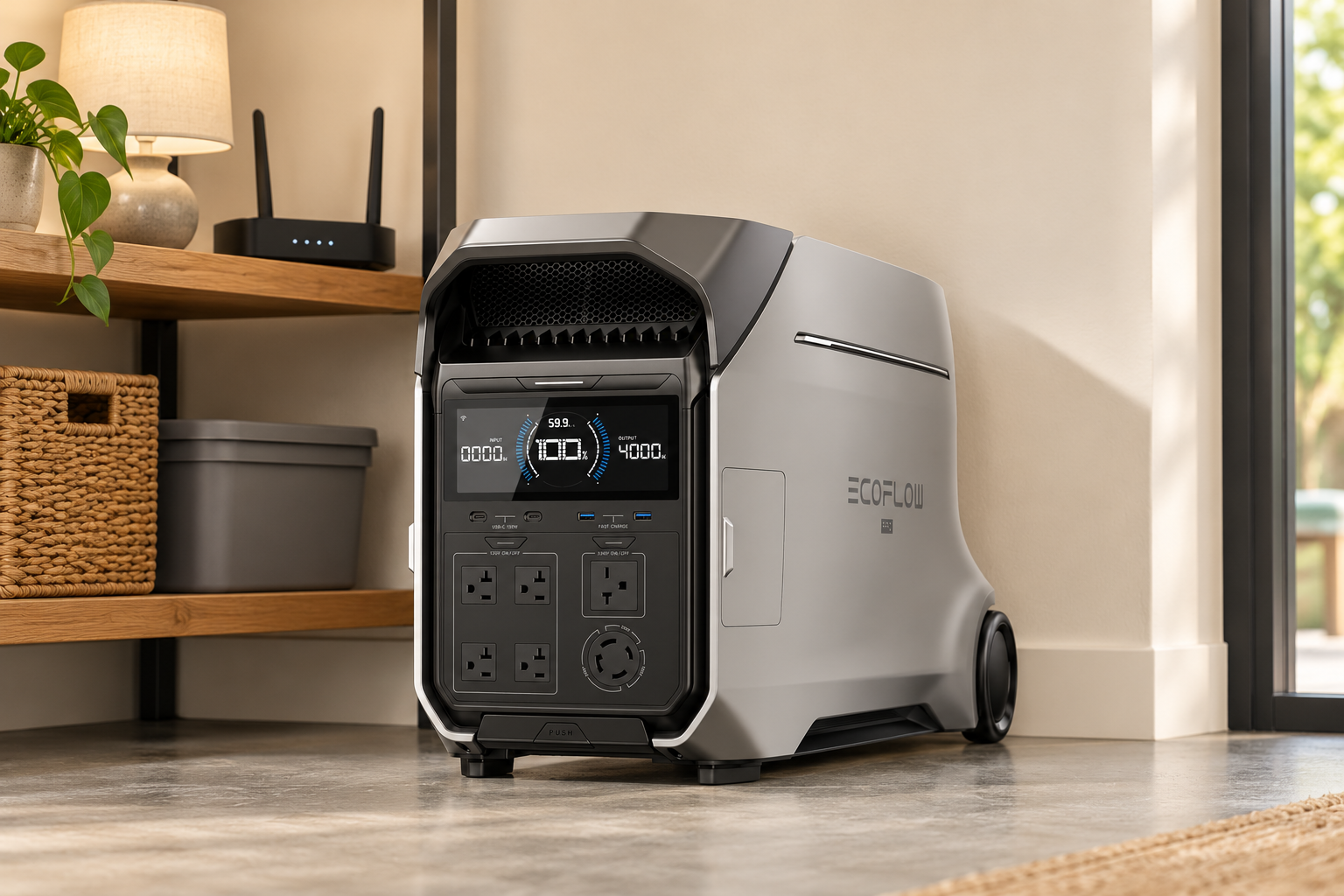
On this page
Short answer: The EcoFlow DELTA Pro 3 is a candidate for a planned essentials-only backup system when its 4,096Wh battery, output modes and substantial weight fit the loads you actually need. Do not buy it on a blanket promise of whole-home power for several days. Measure the loads, plan recharge opportunities and confirm any home-circuit installation separately.
This documentation-based buying analysis uses EcoFlow's official DELTA Pro 3 manual and Amazon US ASIN B0D14FMFZD, reviewed October 22, 2026. Delivered energy, appliance starting performance, transfer behavior and long-term battery life remain unverified. The product scene is AI-generated from the exact reference, not a photographed installation or an output measurement.

Our top picks
- For a measured essentials-only backup planEcoFlow DELTA Pro 3 Portable Power StationSee on AmazonPaid link
AI-generated staging based on the exact product reference. Display values and surrounding devices are illustrative, not measured results or included accessories.
EcoFlow DELTA Pro 3: capacity is not output
EcoFlow's manual identifies a 4,096Wh LiFePO4 battery. The US listing advertises 4,000W AC output and 120/240V capability. Watt-hours describe stored energy; watts describe power at a moment. Neither figure alone tells you how long a home will run.
| Planning item | Documented figure or boundary | What to check for your use |
|---|---|---|
| Battery capacity | 4,096Wh nominal | Usable delivered energy is lower and load-dependent |
| US AC output | Listing advertises 4,000W | Mode, socket limits and appliance starting requirements |
| Voltage configuration | US 120/240V capability | The manual's HV/LV operating restrictions |
| Transport | Listing weight about 115 lb | Stairs, thresholds, storage and safe handling |
| Package | Linked single power-station unit | Extra batteries, panels and home equipment are separate selections |
The manual notes that the US model's high- and low-voltage AC output controls cannot be enabled at the same time; enabling one disables the other. Do not interpret a marketing voltage label as proof that every socket can power every proposed load simultaneously. Check the precise operating mode and socket instructions.

Write an energy list before choosing accessories
List each essential device, its measured or well-supported average power, the hours it must run and any starting surge. A router, light and refrigerator create different load patterns. A nameplate is a useful limit, but it may not be a realistic daily average for a cycling appliance.
As a purely hypothetical worksheet, a continuous 100W load for 8 hours consumes 800Wh. This multiplication is not a DELTA Pro 3 runtime result. It excludes conversion losses, inverter overhead, temperature effects and reserve settings. Add the energy requirements of all intended devices and leave room for uncertainty; do not use the nominal battery figure as a guaranteed amount delivered to AC appliances.

Plan power mode and starting requirements
Compare each appliance with the supported voltage, frequency, socket and operating limits in the current US manual. Large motors and heating loads can require a very different plan from small electronics. A high headline wattage does not establish that an unknown appliance will start reliably.
A practical pre-use check is to confirm supported loads and operating mode with the manufacturer, then assess the actual intended equipment in a controlled setting following the manuals. We provide no guarantee for medical or other critical equipment and no measured transfer-time result. Match critical-use requirements independently rather than relying on a retail feature badge.
Mobility is a route, not a set of wheels
The observed listing weight is about 115 lb. Wheels and a telescopic handle can help on a suitable surface; they do not remove the problem of stairs, lifting into a vehicle or crossing a high threshold. Check the whole route between storage, charging and the intended operating position.
Keep the station in the dry, ventilated environment required by the manual, with vents unobstructed and access to controls. The outdoor solar panel's protection rating does not make this power station waterproof. Plan storage and maintenance so the battery is ready when needed.

Recharge and home circuits require separate decisions
A backup plan needs a realistic route to recharge the battery after use. Solar input depends on the exact panel, the station's input ratings and actual sunlight. A panel's rated watts do not establish a guaranteed refill time. Read our EcoFlow 220W bifacial panel compatibility guide before selecting a solar bundle.
For building circuits, EcoFlow's manual requires a properly installed isolation/transfer arrangement to separate backup power from the grid. Use the manufacturer's supported home equipment and a qualified electrical professional under local requirements. Do not improvise a connection through a home wall outlet. The single unit linked here does not by itself establish a completed home-backup installation.
EcoFlow DELTA Pro 3: For a planned essentials backup system
See the DELTA Pro 3 single US unit on Amazon (Paid link)
The original DELTA Pro is a different model. Compare its documented limits in our original 3,600Wh DELTA Pro guide rather than treating the names as interchangeable.

FAQ
Does 4,096Wh mean 4,096W of output? No. Wh measures energy and W measures power. The capacity and the AC-output rating describe different constraints.
How many days will it power my home? There is no universal answer. Define the essential loads, operating hours, surge requirements and recharge plan. We supply no measured whole-home runtime.
Are solar panels and an extra battery included? This article links a single-unit selection. Confirm the retailer's exact bundle and included accessories before ordering.
Can I connect it directly to house wiring? Home-circuit integration requires the supported equipment, proper grid isolation and qualified installation described by the manufacturer and applicable local requirements.
Sources and method
- EcoFlow DELTA Pro 3 official English manual, with US examples
- Exact Amazon US single-unit listing (Paid link)
Manufacturer specifications, retailer package details and the hypothetical energy worksheet are separate forms of evidence. No fixed Amazon price, customer star rating or measured appliance runtime is presented.
How we evaluated
- Charts from real data: 4
More from VoltLore
EcoFlow 220W Bifacial Panel: Check the Generation and Solar Input
Verify the EcoFlow 220W bifacial panel generation, electrical input match, charging cable and sunny placement before planning energy yield.
Anker SOLIX C2000 Gen 2: Is a 2kWh Backup Worth the Weight?
A 2,048Wh battery can make an essentials-only outage plan practical. We examine the C2000 Gen 2's charging conditions, carrying weight and output limits before you buy.
EcoFlow DELTA 3 Max: Check the 500W Solar Limit Before Buying
The standard DELTA 3 Max offers a 2,048Wh battery, but a good solar backup plan depends on refill speed and operating mode. Here are the limits that matter.