
Anker SOLIX C2000 Gen 2: Is a 2kWh Backup Worth the Weight?
A 2,048Wh battery can make an essentials-only outage plan practical. We examine the C2000 Gen 2's charging conditions, carrying weight and output limits before you buy.
As an Amazon Associate, VoltLore earns from qualifying purchases. This is a desk-researched buying guide, not a hands-on review. Original diagrams use stated assumptions; the AI scene is not a photograph of this product.
Images in this story
Image 1 of 3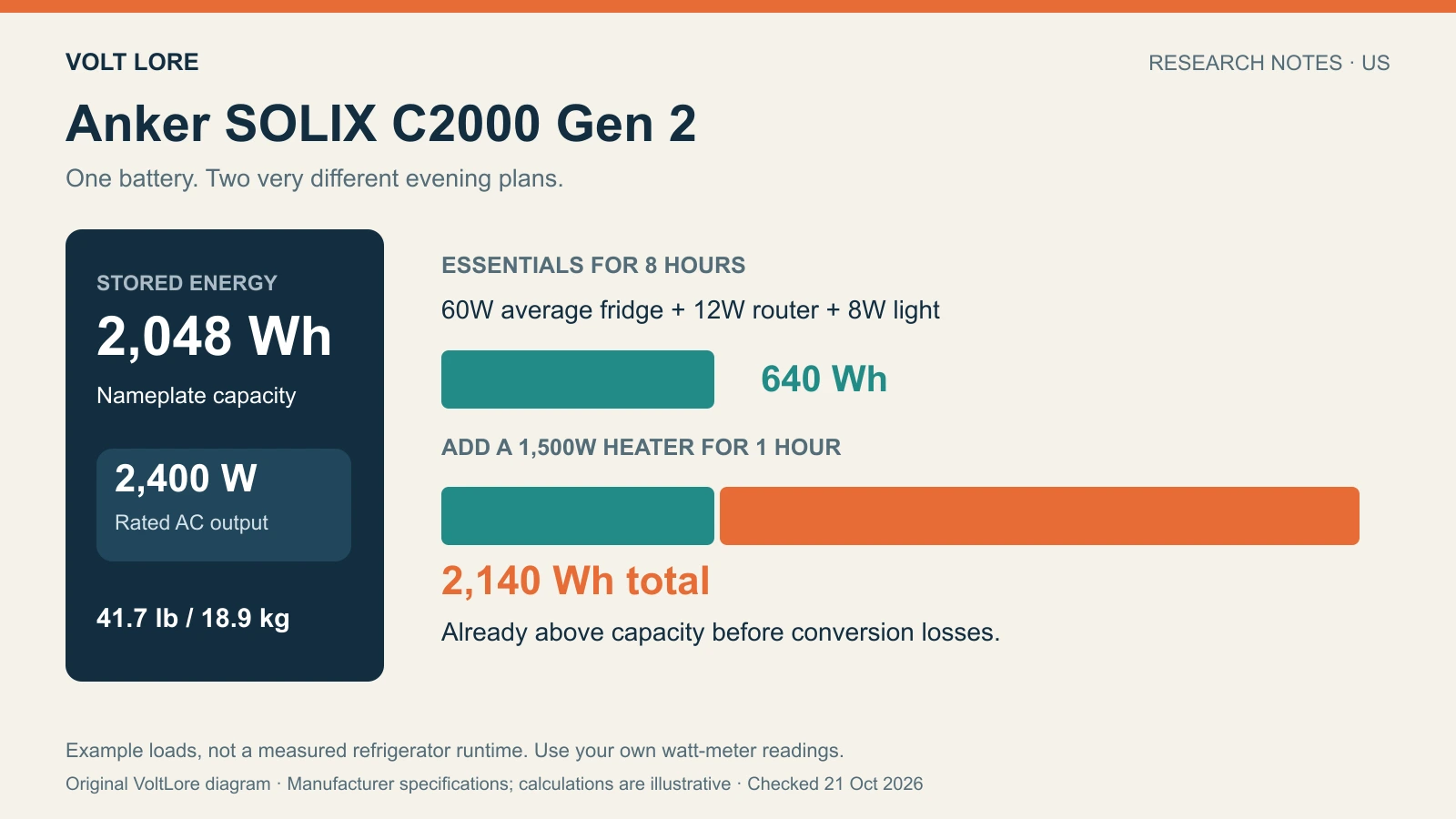
Products in this image
- For measured home essentialsAnker SOLIX C2000 Gen 2 · US 120V, 2048Wh, station onlySee on AmazonPaid link
On this page
Short answer: The Anker SOLIX C2000 Gen 2 is worth considering for a household that wants to keep a few essential devices running through a shorter outage and can give a substantial battery a permanent home. Its appeal is the combination of useful stored energy and a fast refill path. If your real requirement is daily stair carrying, electric space heating or 240V equipment, start with a different plan.
This guide covers the US 120V model A1783, 2,048Wh, station-only Amazon listing B0FVFGL38H. Checked October 21, 2026. We have not performed a hands-on test.

Our top picks
- For measured home essentialsAnker SOLIX C2000 Gen 2See on AmazonPaid link
Original VoltLore diagram. Loads are illustrative assumptions, not measured appliance consumption or tested battery performance.
Anker SOLIX C2000 Gen 2 specifications at home
| Verified specification | Buying implication |
|---|---|
| 2,048Wh LFP battery | Size the energy budget before counting outlets. |
| 2,400W rated AC output; 4,000W peak | Peak capability does not provide sustained 4,000W power. |
| 41.7lb / 18.9kg; 18.1 × 9.8 × 10.1in | Measure the shelf and the route from storage to the appliance. |
| BP2000 Gen 2 expansion support | Check the exact battery generation before ordering an accessory. |
| US TT-30R: 120V, 20A, 2,400W maximum | A familiar RV connector does not make this a 30A supply. |
Source: Anker's US specification sheet and FAQ. These are manufacturer ratings, not our test results.
The weight is a meaningful compromise. A station that stays beside a home-office setup may be practical; one you must retrieve from an upstairs closet during every interruption may not be. Plan a stable, dry, ventilated location with room for plugs and cooling, not merely a shelf that matches the enclosure dimensions.
Build an evening budget before buying
Consider an eight-hour plan with an assumed 60W average refrigerator load, a 12W router and an 8W light. Energy use is:
(60 + 12 + 8)W × 8 hours = 640Wh.
That is the load-side requirement. Battery energy must also cover conversion losses, standby use and any reserve you choose to keep. A refrigerator cycles, so a brief compressor reading is a poor substitute for a full-day watt-meter measurement. Starting demand must also fit the output capability.
Now add a 1,500W heater for one hour: 640 + 1,500 = 2,140Wh. The revised plan exceeds the battery's nameplate capacity even before losses. This is why a list of devices that can switch on is less useful than an energy budget with operating times.

AI-generated conceptual scene. The generic battery is not an image of the C2000 Gen 2; the scene does not demonstrate runtime or installation.
Before an outage, measure the refrigerator over a representative day, set a reserve, then trial your proposed loads while normal power is available. Keep an appliance thermometer in the refrigerator: a battery display alone cannot establish food safety. The FDA's outage guidance explains temperature checks and food handling.
Read the charging claim carefully
Anker lists 58 minutes from empty to full with up to 2,600W of combined AC and solar input. Its separate AC-only figure is 88 minutes at up to 1,800W. Both are manufacturer test figures; conditions affect the result. See the official charging comparison.

Original diagram of manufacturer claims. These are different input arrangements, not competing measurements of the same wall-charge test.
Choose your refill plan around the source you will actually have. A household relying on a wall outlet should budget around the AC path. For solar, verify panel electrical compatibility, usable sun and the cost of the complete kit; a panel's printed wattage is not a daily energy forecast.
Who should buy it, and who should pass?
Shortlist it if you have measured modest essential loads, a convenient storage position and a realistic way to recharge. Its rated output gives flexibility, but the buying decision should still start with hours of service needed.
Compare a smaller station if you mainly need phones, networking and a laptop and portability matters more than runtime. Compare a larger system if your budget already exceeds this battery before losses, or if several days without a reliable refill source are the normal scenario.
For an expandable alternative, compare the exact expansion accessories and total installed cost, not just the base battery price. Our C1000 Gen 2 guide examines a smaller option. Use the multi-day home-backup planning guide to assess a longer outage.
Questions worth resolving before checkout
Is the TT-30 outlet a full 30A RV source?
No. Anker's US table limits that outlet to 20A / 2,400W at 120V. Budget simultaneous loads within the station's limits and follow the manual for connections.
Can I treat the battery's full capacity as usable AC energy?
No. Nameplate capacity is a starting point. Load, conversion losses, reserve settings, temperature and battery condition affect usable energy and runtime. Our 640Wh example is a calculation of demand, not a prediction of this unit's measured efficiency.
Why cover this model now?
Our US Google Trends check of the query Anker SOLIX C2000 found a higher average index in September 23–October 20 than in August 26–September 22, 2026. The latest seven-day average had cooled. This is a relative search-attention signal, not sales, absolute search volume or proof of reliability. View the query comparison.
Method and sources
VoltLore compared the US manufacturer's ratings, the exact Amazon model/variant and a dated search-trend snapshot. Suitability judgments and energy arithmetic are ours; long-term reliability, usable capacity and noise were not independently tested. We omit live prices and customer-star summaries because listings change.
Use the buying button for C2000 Gen 2, US 120V, station only. Confirm the selected variant, seller, included cables, warranty eligibility and return terms on Amazon. Solar panels and an expansion battery should never be assumed included unless the selected bundle expressly lists them.
Sources: Anker SOLIX US specifications and charging claims; FDA outage food-safety guidance.
- Charts from real data: 2
More from VoltLore
EcoFlow DELTA 3 Max: Check the 500W Solar Limit Before Buying
The standard DELTA 3 Max offers a 2,048Wh battery, but a good solar backup plan depends on refill speed and operating mode. Here are the limits that matter.
BLUETTI Elite 100 V2: Is 1kWh Enough for Your Camping Trip?
Assess the Elite 100 V2's 1,024Wh battery, carrying weight and charging options using an overnight energy worksheet and the limits in BLUETTI's US manual.
Jackery Explorer 2000 v2: A Practical Home Backup Guide
Assess the Explorer 2000 v2 around essential loads, its fixed 2,042Wh battery, carry weight and solar-input limits before choosing a home-backup station.