
Jackery Explorer 2000 v2: A Practical Home Backup Guide
Assess the Explorer 2000 v2 around essential loads, its fixed 2,042Wh battery, carry weight and solar-input limits before choosing a home-backup station.
As an Amazon Associate, VoltLore earns from qualifying purchases. This article is a specification-based analysis.
Images in this story
Image 1 of 2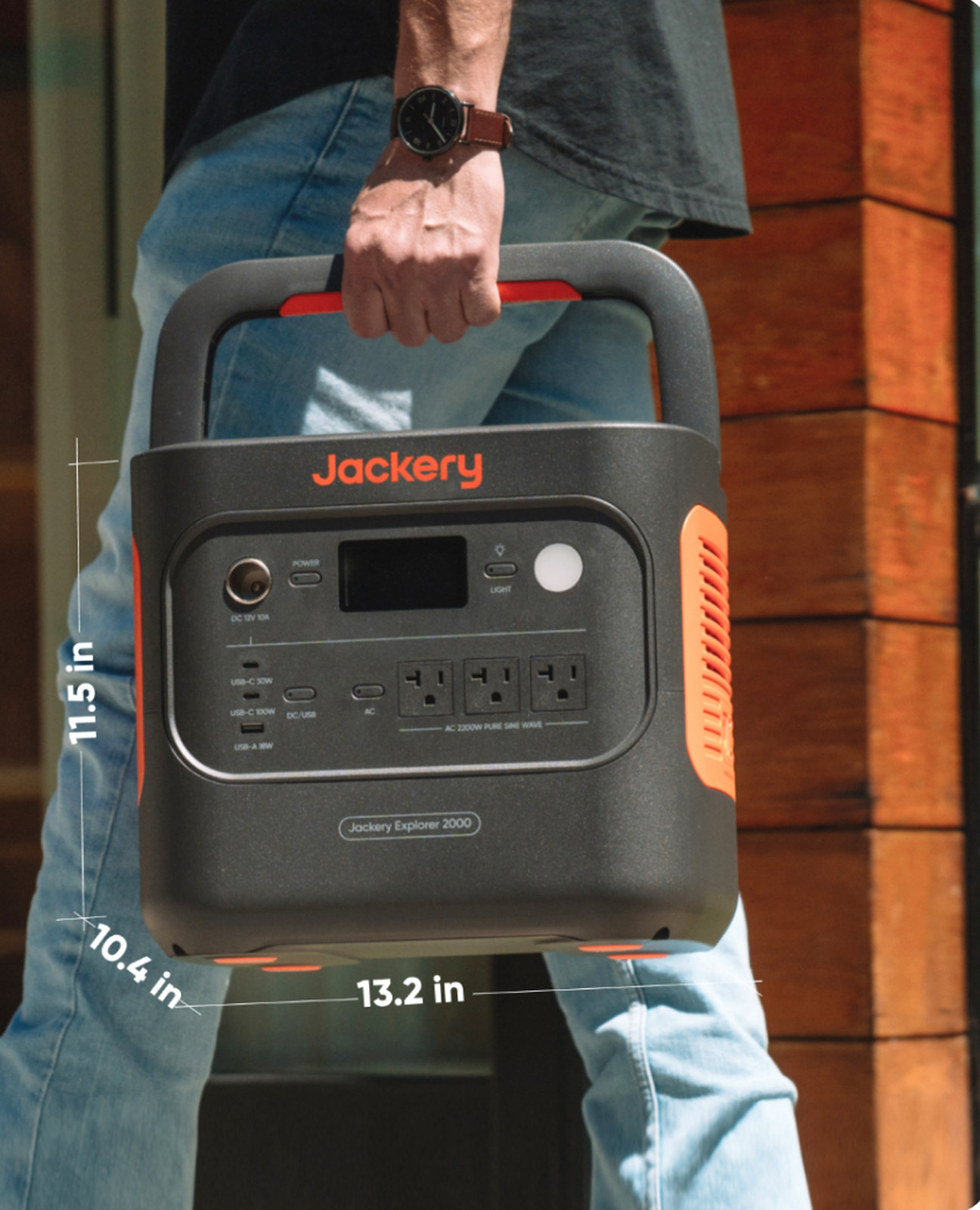
Products in this image
- For selected home essentials with a recharge planJackery Explorer 2000 v2 · US 2,042Wh / 2,200W station-onlySee on AmazonPaid link
On this page
Quick answer: The Jackery Explorer 2000 v2 is worth considering when you want a fixed-capacity battery for selected household essentials and can manage its roughly 40-pound weight. Its appeal is the middle ground between a small camping battery and a much heavier expandable system. Buy it around a measured energy budget and a recharge plan. Skip it if your plan depends on adding batteries later, running 240V equipment, or guaranteeing uninterrupted power to critical equipment.

Our top picks
- For selected home essentials with a recharge planJackery Explorer 2000 v2See on AmazonPaid link
US Jackery Explorer 2000 v2 (2,042Wh), carried by its handle in a manufacturer-supplied photograph. Cropped from the official US launch media image. Image: Jackery / GlobeNewswire. Official press source.
What the Explorer 2000 v2 actually gives you
The US model is JE-2000D. Jackery lists a 2,042Wh LiFePO4 battery, 2,200W of total continuous AC output, three 120V AC outlets and a weight of about 39.5lb. These are manufacturer specifications, not our measurements. The ordinary station package contains the unit and an AC charging cable; a solar panel shown in a bundle photograph is not automatically included. Jackery product specifications and package contents.
| Listed feature | What it changes when choosing |
|---|---|
| 2,042Wh storage | The energy budget available before conversion losses and reserve |
| 2,200W rated AC output, shared across the outlets | The combined load ceiling, not a promise of long runtime |
| 39.5lb carry weight | Moving it occasionally may be practical; repeatedly carrying it upstairs is a different purchase decision |
| Three 120V outlets | Check the plugs on your essential devices and your cable arrangement |
| Fixed capacity | Decide whether the battery is large enough before purchase |
Do not confuse the Explorer 2000 v2 with the Explorer 2000 Plus or the newer HomePower 2000 Plus v2. Similar names conceal different systems. Match the product name, JE-2000D model and the listing you intend to buy. Jackery explicitly says the Explorer 2000 v2 is not expandable. Official product FAQ.
Start with an eight-hour load worksheet
A power station can support an appliance's running wattage and still run out of energy too soon. The EIA distinguishes watts from watt-hours: power describes a load at a moment; energy accounts for that load over time.
Here is an illustrative planning exercise, rather than a measured product runtime. Replace every assumption with your own measurement.
| Example load | Assumption | Energy |
|---|---|---|
| Refrigerator | 60W average over eight hours | 480Wh |
| Router and modem together | 15W for eight hours | 120Wh |
| LED light | 10W for five hours | 50Wh |
| Two phone recharges | 15Wh per phone | 30Wh |
| Laptop | 60W for three hours | 180Wh |
| Total | Selected essentials only | 860Wh |
The arithmetic total is about 42% of the listed battery capacity. That leaves headroom on paper, but it does not verify the plan. Inverter consumption, conversion losses, battery reserve, temperature and actual appliance behavior all change the result. A refrigerator also cycles and has a starting demand: an average wattage is not its startup requirement.
The useful purchase question is whether your own essential-load total leaves a comfortable margin. If you have to assume every device uses the smallest plausible amount of energy, the plan is already fragile. Our power-station sizing guide explains how to build a household inventory.
Heating is where the plan changes quickly
Suppose the example above also includes a 1,500W heater for one hour. That adds 1,500Wh and takes the worksheet to 2,360Wh. It exceeds the battery's nameplate capacity even before losses. A sufficiently powerful outlet cannot overcome that energy shortfall.
Cooking can be a smaller but still meaningful decision. A hypothetical 1,000W appliance used for 30 minutes adds 500Wh. Decide in advance whether that energy is more valuable than keeping the refrigerator and communications equipment running longer.
This is why we would shop this model for a deliberately selected set of essentials. A broad promise that it will run a house for a day misses the decisions that determine whether it will work for you.

Original VoltLore energy-budget calculation. Loads are hypothetical; nominal capacity is the manufacturer specification. Values are before conversion losses and reserve.
Jackery Explorer 2000 v2 solar charging
Jackery's current US support table specifies up to 200W from one solar input and 400W using both. It lists approximately 7.5 hours with two SolarSaga 200W panels under its reference conditions. Those figures do not establish the solar yield at your home.
The ideal arithmetic lower bound at a constant 400W is 2,042Wh divided by 400W, or about 5.1 hours. That is an energy calculation, not a charge-time forecast. Clouds, shade, panel position, charging behavior and simultaneous device use can extend the process.
The two DC inputs are parallel rather than independent trackers. Jackery requires matching panel arrangements and does not support using solar and car charging together. Check the exact panel, voltage, connectors and cables before buying a third-party setup. A panel's watt rating alone is insufficient. The JE-2000D manual is another useful reference for the electrical limits.
For a multi-day outage, write down where tomorrow's energy comes from. If there is no workable recharge opportunity, reduce the loads or compare a different system. See our guide to planning backup for days.
Is this the right Jackery portable power station for you?
You expect to expand later. A fixed battery should fit the plan you are buying it for. Do not purchase it assuming an add-on pack will solve a future capacity shortfall.
You need uninterrupted or safety-critical power. Jackery describes a transfer within 20 milliseconds and warns that this is not a zero-interruption UPS. Its safety FAQ does not recommend medical, life-support or business-critical applications. A power-station shopping comparison cannot establish that equipment's backup requirements.
You will move it often. Measure the storage space, check the route to your intended operating location, and consider whether one person can safely handle the unit. A compact shape and an acceptable lifting weight are separate requirements.
Before ordering on Amazon
The verified US station listing is ASIN B0DFG2WDQH. Recheck that it says Explorer 2000 v2 and that the selected option contains the accessories you expect. Confirm seller, warranty eligibility, delivery terms and return conditions at checkout. We do not reproduce a temporary price or stock claim here.
The most useful final check is a written list: devices, measured energy, starting demands, intended hours, compatible cables and the next recharge source. If one of those remains unknown, resolve it before interpreting a headline wattage as a buying answer.
See on Amazon(Paid link)
FAQ
Will it run my refrigerator all night?
Possibly, but the refrigerator's measured energy use and starting demand are needed to judge the plan. The worksheet above is an example, not a runtime promise for your appliance.
Can I add a Jackery battery pack later?
Jackery says this Explorer 2000 v2 is not expandable. Other Jackery models with similar names have different capabilities.
Does the station-only listing include solar panels?
No panel is listed in the basic station package. A solar-generator bundle is a separate configuration; inspect the selected listing.
Method and sources
This is a specification-based buying analysis, checked October 21, 2026. We consulted Jackery's US product page, its current support table, the JE-2000D manual and the EIA's explanation of electricity measurement. An original laboratory or field evaluation is outside the scope of this document-based analysis. The load worksheet and ideal solar calculation are our explicit examples; manufacturer specifications remain manufacturer claims.
- Charts from real data: 1
More from VoltLore
Portable power station for home backup: plan for days
Size a backup battery around essential loads and a realistic recharge plan, then compare a compact and an expandable station by their listed specifications.
Portable Power Station vs Gas Generator for Home Power Outages
A battery power station suits apartments, short outages and small loads because it makes no exhaust. A gas generator suits multi-day outages and big loads, but only outdoors. Many homes end up using both.
How Big a Portable Power Station Do You Need for a Power Outage?
Add up the watts you need at the same time, then the watt-hours you need for the whole outage. A fridge, router, lights and phones for one day come to roughly 1.6 kWh, so look at stations rated near 2,000 Wh.