
EcoFlow DELTA 3 Max: Check the 500W Solar Limit Before Buying
The standard DELTA 3 Max offers a 2,048Wh battery, but a good solar backup plan depends on refill speed and operating mode. Here are the limits that matter.
As an Amazon Associate, VoltLore earns from qualifying purchases. This is a desk-researched buying guide, not a hands-on review. Original diagrams use stated assumptions; the AI scene is not a photograph of this product.
Images in this story
Image 1 of 3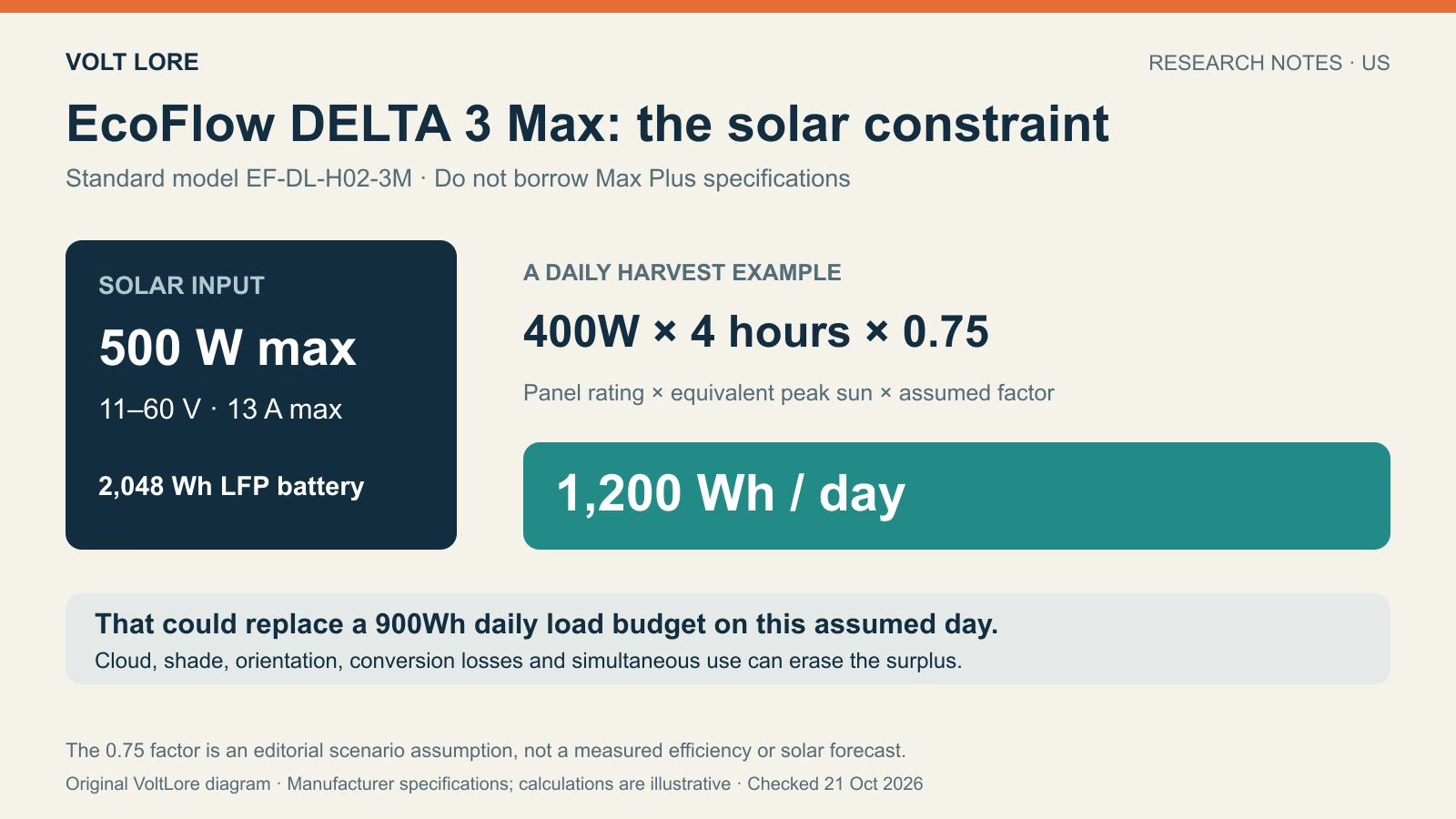
Products in this image
- For measured essential loads with planned rechargingEcoFlow DELTA 3 Max · US 120V, standard DELTA 3 Max, 2048Wh, station onlySee on AmazonPaid link
On this page
Short answer: The EcoFlow DELTA 3 Max is a plausible choice for measured essential loads with periodic access to mains charging. For a solar-first setup, its 500W maximum solar input deserves attention before the battery's capacity does. A useful battery can still be a poor fit when each day consumes more energy than the panels replace.
This article covers the standard US DELTA 3 Max, model EF-DL-H02-3M, 2,048Wh, Amazon ASIN B0FQV6LMVX. It does not transfer specifications from DELTA 3 Max Plus, DELTA 2 Max or the older DELTA Max. Checked October 21, 2026; this is desk research, not a hands-on test.

Our top picks
- For measured essential loads with planned rechargingEcoFlow DELTA 3 MaxSee on AmazonPaid link
Original VoltLore diagram. The solar-harvest calculation uses an assumed day and loss factor, not a weather forecast or a measured result.
EcoFlow DELTA 3 Max specifications that matter
| US standard-model specification | What to plan around |
|---|---|
| 2,048Wh LFP battery | Stored energy and daily refill are separate questions. |
| 2,400W total AC output in battery mode | All AC loads share this rating. |
| Solar input: 11–60V, 13A, 500W maximum | Check voltage and current compatibility, not only panel wattage. |
| Approximately 44.8lb / 20.3kg; IP20 | Plan the lifting route and a dry, ventilated operating location. |
Source: EcoFlow's DELTA 3 Max manual, US specifications.
The important ownership question is where it will live between uses. A vehicle-based campsite or a ground-floor backup position presents a different carrying problem from a third-floor apartment. Avoid treating the word portable as a promise that the unit will be comfortable for every person to move.
Can solar replace what you use each day?
Use a planning example: a compatible 400W panel array, four equivalent peak-sun hours, and an assumed 0.75 delivery factor.
400W × 4h × 0.75 = 1,200Wh per day.
The factor is an editorial allowance for a scenario, not an EcoFlow efficiency claim. Equivalent peak-sun hours represent solar energy over the day; they do not mean four ordinary daylight hours at full output. Shade, weather, panel orientation and conversion losses can change the result substantially.
If your loads require an assumed 900Wh per day, that scenario leaves 300Wh before any additional standby use or other losses not captured in the assumptions. If the same setup gets only two equivalent peak-sun hours, calculated harvest falls to 600Wh and the battery's reserve declines. A larger battery delays the problem; it does not eliminate the daily energy deficit.

AI-generated planning scene, not a photograph of the DELTA 3 Max. The devices are unconnected; this is not a wiring or weatherproofing demonstration.
Before ordering panels, compare their open-circuit voltage, current, connector and proposed array arrangement with the manufacturer's instructions. Keep the battery dry with ventilation available. If a proposed layout needs a more capable solar input, select the power station first and then match its panels.
Battery mode and AC bypass have different limits
The US manual lists 2,400W total in battery discharge mode, but 13A total in AC bypass mode. At 120V, 13A corresponds to about 1,560W. That distinction matters if you leave appliances connected while the station is plugged into the wall. The manual also warns that inadequate input relative to connected loads can compromise charging and backup operation. Read the operating instructions.

Original diagram based on the US manual. The 1,560W value is 120V × 13A; actual supply voltage can vary.
EcoFlow advertises 3,400W X-Boost support for this US model. Treat that as a separate compatibility feature, not a higher continuous inverter rating. The manual says it is unavailable during AC charging/bypass and unsuitable for some voltage-protected equipment. Size critical loads using the applicable rated limits and verify the exact device's requirements.
The standard model is not Max Plus
The US series page discusses both versions together. Its standard-model description gives a manufacturer 0–80% wall-charge time of 68 minutes; that is not a full-charge time. The same page advertises higher output and expansion for Max Plus. Those claims must not be applied to the standard model.
The standard model's manual lists its ports and compatible accessories without listing an extra battery. We would not buy it on an assumption of future battery expansion. If expansion is essential, choose an explicitly supported model-and-battery combination and verify the connection before checkout.
Who should shortlist it?
Consider it if you can measure an essentials-only load budget, recharge periodically, store it conveniently and work within the solar and bypass limits. A fixed base for networking, lighting and selected appliances is a more convincing use case than buying solely for the largest marketing wattage.
Compare alternatives if you need substantial daily solar replenishment, regular stair carrying or guaranteed growth through extra batteries. Our Jackery Explorer 2000 v2 guide examines another 2kWh option. Use the multi-day backup planning guide to evaluate a longer outage. Compare the complete system, including panels, cables and accessories.
Questions before checkout
Will a 500W panel always deliver 500W?
No. Panel nameplate power and actual harvest differ. The station's 500W limit is a ceiling, not a promised input throughout the day. Build a pessimistic-weather case as well as a favorable-day budget.
Is the advertised 10ms switchover a guarantee for every device?
No. EcoFlow lists a 10ms transfer claim on its US series page, but equipment tolerance and the complete setup still matter. Test your actual non-critical setup before relying on automatic backup; do not assume the claim establishes medical or other safety-critical suitability.
Why is this model on our shortlist now?
For the US query EcoFlow DELTA 3 Max, our Google Trends snapshot showed a higher average index in September 23–October 20 than in August 26–September 22, 2026, while the latest seven-day average declined. This measures relative attention, not sales or quality. View the query comparison.
Method and sources
VoltLore checked the standard US manual, the manufacturer's series page, the Amazon variant and a dated trend snapshot. The arithmetic and buying judgments are editorial analysis. We did not independently measure usable capacity, long-term reliability or noise, and do not reproduce changing prices or star ratings.
Select DELTA 3 Max, standard 2,048Wh, US 120V, station only using the buying button, then confirm that Amazon has kept that exact variant selected. Check seller, included accessories, return terms and warranty conditions; the manufacturer's US page describes three years of standard coverage plus a two-year extension with EcoFlow app registration.
Sources: EcoFlow DELTA 3 Max user manual; EcoFlow US series page, separate standard and Plus claims.
- Charts from real data: 2
More from VoltLore
Solar Panel Generator for Camping: Is a 45W Panel Enough for the RIVER 3 Plus?
A 45W panel is a modest solar source for the 286Wh RIVER 3 Plus: plan around phones and lights, do the charging arithmetic, and confirm the exact panel variant before buying.
Anker SOLIX C2000 Gen 2: Is a 2kWh Backup Worth the Weight?
A 2,048Wh battery can make an essentials-only outage plan practical. We examine the C2000 Gen 2's charging conditions, carrying weight and output limits before you buy.
BLUETTI Elite 100 V2: Is 1kWh Enough for Your Camping Trip?
Assess the Elite 100 V2's 1,024Wh battery, carrying weight and charging options using an overnight energy worksheet and the limits in BLUETTI's US manual.