
BLUETTI Elite 100 V2: Is 1kWh Enough for Your Camping Trip?
Assess the Elite 100 V2's 1,024Wh battery, carrying weight and charging options using an overnight energy worksheet and the limits in BLUETTI's US manual.
As an Amazon Associate, VoltLore earns from qualifying purchases. This article is a specification-based analysis.
Images in this story
Image 1 of 2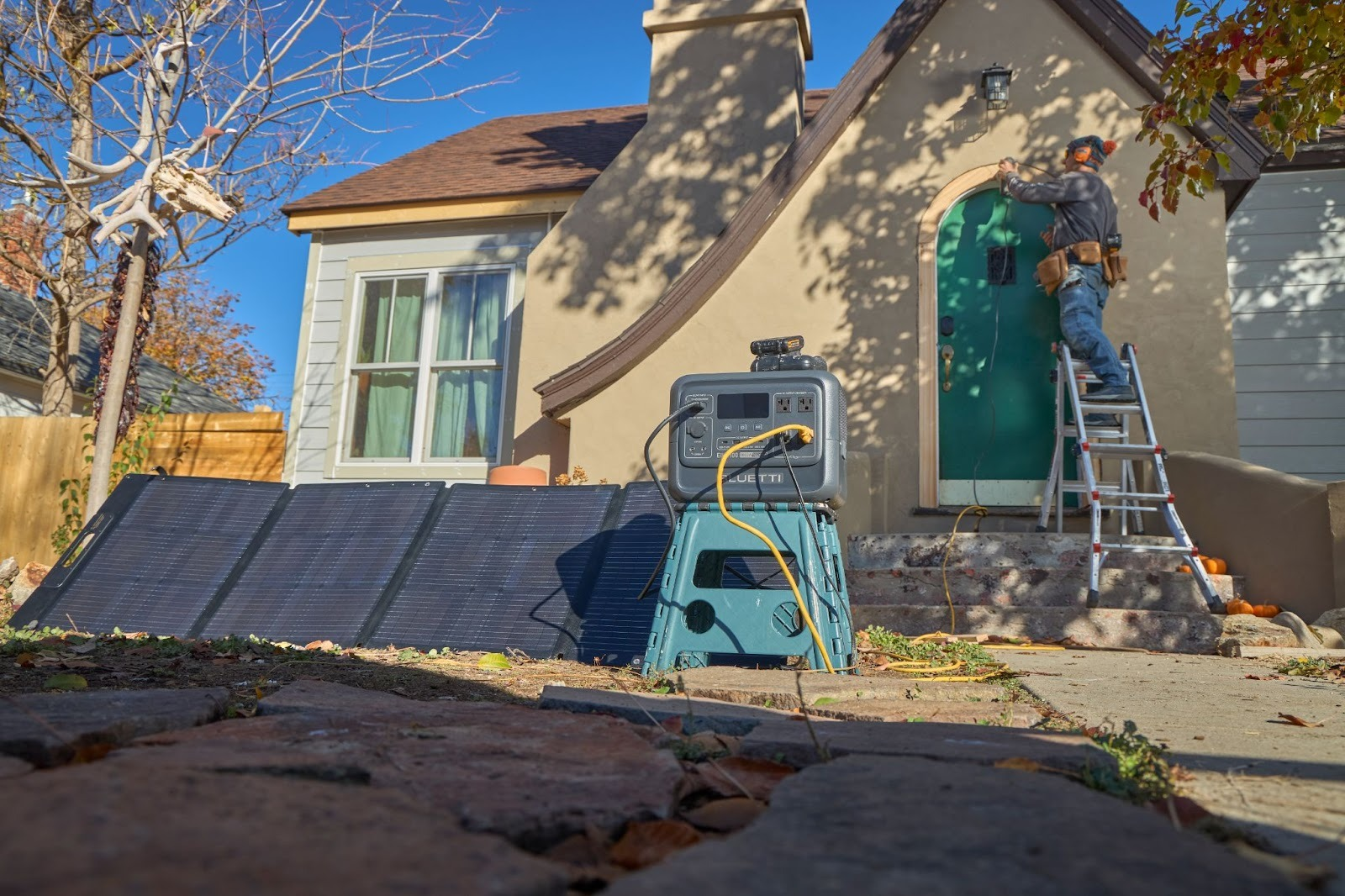
Products in this image
- For a measured overnight camping planBLUETTI Elite 100 V2 · US 1,024Wh / 1,800W station-onlySee on AmazonPaid link
On this page
Quick answer: The BLUETTI Elite 100 V2 is a useful candidate for campers and short-outage planners who need AC outlets and about 1kWh of stored energy in a unit weighing roughly 25lb. Its charging options are a stronger reason to investigate it than a headline appliance list. Choose it for a specific load schedule; skip the assumption that a powerful inverter makes a small battery suitable for extended heating, cooking or an entire RV.

Our top picks
- For a measured overnight camping planBLUETTI Elite 100 V2See on AmazonPaid link
Manufacturer-supplied photograph of the North American BLUETTI Elite 100 V2. The solar panel shown is a separate accessory. Image: BLUETTI / GlobeNewswire. Official press source.
Choosing a portable power station for camping
BLUETTI's US page lists 1,024Wh of LiFePO4 storage, 1,800W of AC output and 11 output ports. It describes a compact 17-liter enclosure with a concealed handle. The marketing weight is rounded to 25lb; the US manual specifies approximately 25.3lb. These are manufacturer specifications. VoltLore’s analysis relies on published documentation. Official US product page.
| Feature | Why it matters |
|---|---|
| 1,024Wh battery | Determines the energy available between charges |
| 1,800W AC output | Limits the loads that can run together |
| About 25.3lb | A carrying decision as well as a storage-space decision |
| Up to 1,200W AC charging | A fast-recharge option when a suitable wall supply is available |
| Up to 1,000W solar input | Potential for a substantial solar setup; panels must satisfy the electrical limits |
The US Elite 100 V2 manual, version 5.1 is the reference for operating limits. Check the selected product and regional version before applying a review of another outlet layout or a similarly named Premium model.
Is 1kWh enough for a camping night?
The best answer starts with your equipment. The EIA explains the difference between power and energy. A device's wattage describes how quickly it uses energy; multiplying watts by hours gives watt-hours.
Consider this hypothetical overnight plan:
| Example load | Assumed use | Energy |
|---|---|---|
| Camping refrigerator | Average 45W for 12 hours | 540Wh |
| Fan | 20W for six hours | 120Wh |
| Light | 8W for five hours | 40Wh |
| Two phone recharges | 15Wh each | 30Wh |
| Total | Illustrative loads only | 730Wh |
That is about 71% of the battery's nominal energy. It does not mean the station will deliver this exact night of service: conversion losses, inverter use, temperature and reserve reduce the energy available to appliances. Your refrigerator may use substantially more or less. Measure its energy over a relevant period instead of substituting an unrelated household's number.
Now add a hypothetical 1,200W cooking appliance for 20 minutes. It needs another 400Wh, taking the worksheet to 1,130Wh. The result exceeds the battery's stated capacity even before losses. This is a reason to change the plan, recharge during the day, or investigate a larger system.

Original VoltLore energy-budget calculation. Loads are hypothetical; nominal capacity is the manufacturer specification. Values are before conversion losses and reserve.
Virginia Cooperative Extension's appliance-energy guide also explains why an appliance label and actual operating consumption can differ. Our outage sizing guide provides a broader household planning method.
How the fast charging can help
BLUETTI advertises 80% charge in 45 minutes using Turbo AC charging. The manual states a 25°C reference condition. Treat that as a maker's conditional charging figure, not a guarantee for every starting charge level, temperature or campsite electrical supply. It also offers Standard and Silent charging modes.
The practical advantage is a shorter stop near a suitable outlet. It does not create energy while you are away from all charging sources. If the trip depends on recharging at a campground, confirm that the site actually offers the supply you intend to use and follow its rules.
BLUETTI Elite 100 V2 solar charging
Solar needs separate planning. The manual permits an array within 12–60V open-circuit voltage, 20A and 1,000W maximum. Compatibility is more than adding panel wattages. Use the connection arrangements in the manual and check the exact panel specifications; do not improvise from the connector's appearance.
For perspective, 1,024Wh divided by a constant 200W is 5.12 hours. That is an ideal energy lower bound before charging losses and variable sunlight. A 200W panel does not deliver its label continuously all day. If the unit also runs the refrigerator while charging, part of the incoming energy serves that load rather than restoring the battery.
Two features to understand before depending on them
Power Lifting is not a larger continuous inverter. The manual limits this mode to suitable resistive loads rated between 1,800W and 2,700W and says the actual output remains 1,800W. Do not interpret the larger figure as permission to run every 2,700W appliance. A device's operating requirements still apply.
The UPS function is conditional backup. BLUETTI specifies a transfer within 10 milliseconds. The manual warns against equipment such as data servers or workstations requiring a high-performance UPS. Choose a backup system around the connected equipment's requirements; a transfer-time headline does not establish compatibility.
For ordinary low-power loads, inspect ECO settings too. The manual describes configurable low-load shutoff thresholds and timers. An output turning off because a load is small can be an unpleasant surprise even when the battery is not empty. Set up and check the intended operating mode before the trip or outage.
What to include in the total purchase
The verified US Amazon station listing is ASIN B0F42CSQWG. Another listing, B0FHWFXYM5, explicitly describes a solar-cable version. A cable and a solar panel are different items. Read the selected option's included-components list rather than inferring the package from a promotional scene.
Make a short accessory list: compatible panel and cable if needed, suitable device leads, and any manufacturer-approved vehicle charging equipment. Price the configuration you will actually use. A cheap station-only listing can be the wrong comparison if another option includes a panel you genuinely need.
BLUETTI now advertises combinations involving Charger 2, B300K and a DC Hub. That does not justify assuming an arbitrary extra battery connects directly to this station. If additional storage is essential, verify the complete supported arrangement and its charging behavior before ordering.
See on Amazon(Paid link)
Who should look at a different class of system?
A reader who wants to carry a station from car to tent and power a carefully chosen overnight setup is a plausible buyer. Someone planning long periods of electric cooking, space heating or air conditioning should calculate that energy first. The ability to start a device and the ability to support the whole trip are separate decisions.
For home backup, compare the result of your load worksheet with a larger capacity class. Our multi-day backup guide explains how to choose that capacity and plan a workable recharge source. More stored energy still needs a recharge plan.
Keep the station dry and ventilated. The manual excludes rain and high-humidity use and specifies a charging range of 0–40°C. A product suited to camping does not make its battery enclosure an all-weather outdoor appliance.
FAQ
Is 1,800W the amount of energy in the battery?
No. It is an output-power rating. Storage is rated at 1,024Wh. High-power devices can consume that energy quickly.
Does a 1,000W solar-input rating mean a panel is included?
No. It describes the station's input limit. Panel and accessory inclusion depends on the selected package.
Where does the advertised charging speed come from?
The figure comes from BLUETTI’s published documentation. Independent measurements of the charging curve, usable energy and noise are outside the scope of this specification-based analysis.
Method and sources
This specification-based analysis was checked October 21, 2026 using BLUETTI's US product information, its US manual, the exact Amazon listing and independent explanations of electricity measurement. Our conclusions rely on the cited documentation and calculations; they do not include an original laboratory or field evaluation. The camping worksheet and solar calculation are our illustrative arithmetic, not observed product performance.
- Charts from real data: 1
More from VoltLore
Jackery Explorer 2000 v2: A Practical Home Backup Guide
Assess the Explorer 2000 v2 around essential loads, its fixed 2,042Wh battery, carry weight and solar-input limits before choosing a home-backup station.
Solar Panel Generator for Camping: Is a 45W Panel Enough for the RIVER 3 Plus?
A 45W panel is a modest solar source for the 286Wh RIVER 3 Plus: plan around phones and lights, do the charging arithmetic, and confirm the exact panel variant before buying.
Portable power station for home backup: plan for days
Size a backup battery around essential loads and a realistic recharge plan, then compare a compact and an expandable station by their listed specifications.