
BLUETTI AC50P: 504Wh Capacity, 700W Output and Buying Checks
A researched BLUETTI AC50P buying guide: distinguish stored energy from continuous output, match actual loads and solar input, and price the complete kit. No physical performance testing.
Quick answer: Consider the BLUETTI AC50P for a modest laptop, phone and camping-light setup when its output and energy budget match your equipment. Skip it for whole-home backup or a routine built around high-wattage heating. Availability checked 28 October 2026: the official US station-only selection showed Out of Stock. Treat this as a research guide and confirm availability before arranging a trip around a new purchase. Our judgment is based on documentation, not physical testing: the useful question is whether it can complete your particular job between recharges.
Images in this story
Image 1 of 2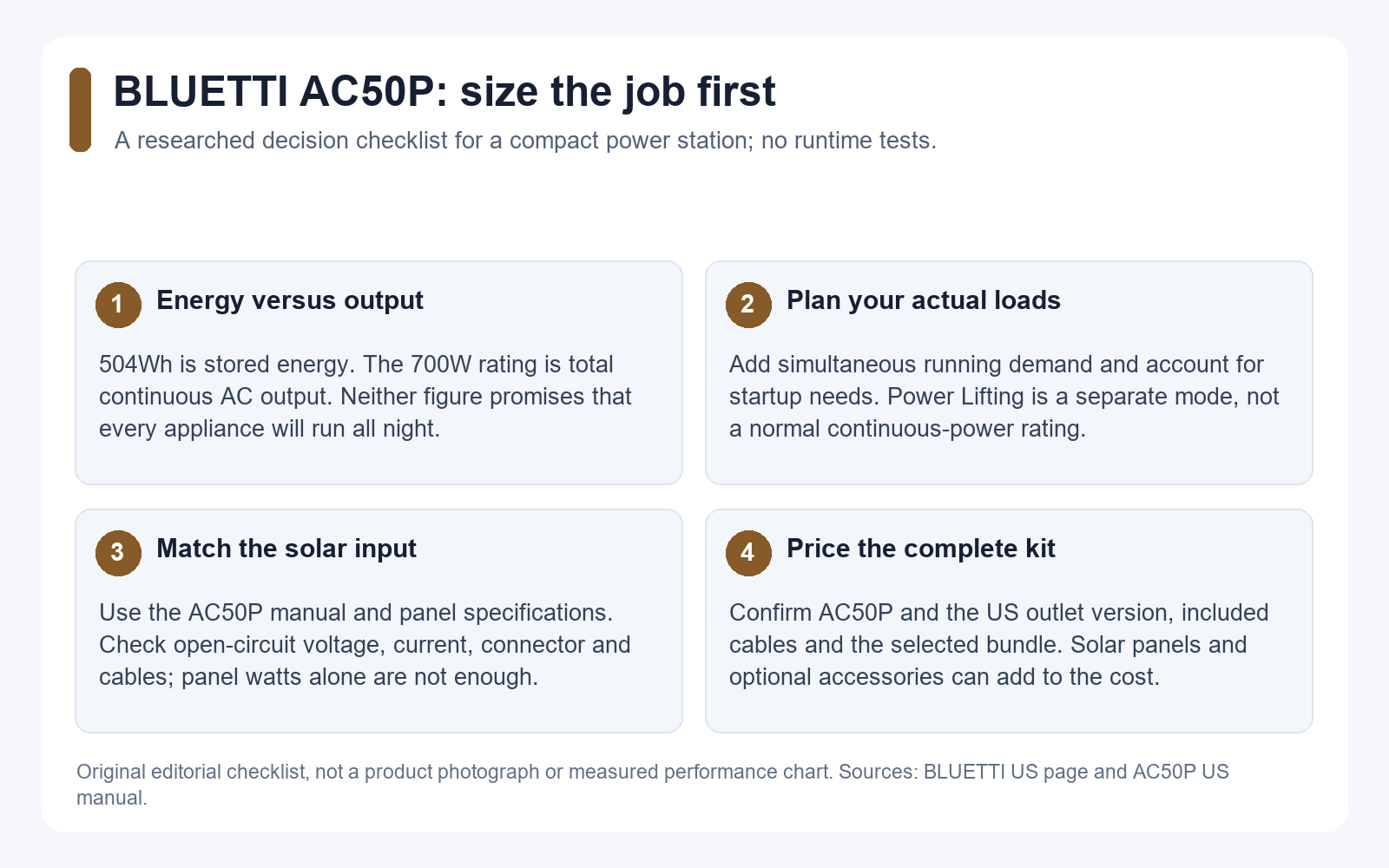
On this page
Quick answer: Consider the BLUETTI AC50P for a modest laptop, phone and camping-light setup when its output and energy budget match your equipment. Skip it for whole-home backup or a routine built around high-wattage heating. Availability checked 28 October 2026: the official US station-only selection showed Out of Stock. Treat this as a research guide and confirm availability before arranging a trip around a new purchase. Our judgment is based on documentation, not physical testing: the useful question is whether it can complete your particular job between recharges.

Where to buy
- Small-load research candidate; official listing out of stockBLUETTI AC50PSee at bluettipower.com
Original editorial decision diagram; not a product photograph or measured runtime chart.

Real product photograph by P1898, photographed August 2026, via Wikimedia Commons, CC BY 4.0. Resized rendition. The AC50P is the smaller unit at upper left. This regional display photograph is not evidence of US outlet configuration, current prices or included accessories. The other units are different models.
Who It Suits and Who Should Skip It
The AC50P makes sense as a candidate for a small, defined set of loads. A remote worker can begin with the laptop charger, phone and light they actually carry. A camper should add any fan, cooler or other device to that same list. The word “portable” does not establish how long the trip can last without another charge.
Skip this size class if your plan starts with electric space heating, a large cooking appliance, or unspecified household circuits. A power station can have enough output to start a task but too little stored energy to continue it for the duration you need. Conversely, having energy left does not make an incompatible load safe to connect.
For a larger camping setup, our BLUETTI Elite 100 V2 guide addresses a different size class. Compare the whole job before choosing the smaller or larger station; this article does not rank their measured performance.
BLUETTI AC50P Specifications and Model Checks
BLUETTI AC50P: Best for a Defined Small-Load Kit
The following values come from the official US AC50P listing and the AC50P US manual, checked on 28 October 2026. They are manufacturer specifications, not our measurements.
| Item | Documented value | Buying implication |
|---|---|---|
| Stored battery energy | 504Wh, LFP chemistry | Stored energy is not all delivered to the appliance. |
| Continuous AC output | 700W total across the AC outlets | Do not read the rating as a separate full allowance for each outlet. |
| US AC voltage | 120V | Match the actual regional unit, not a photograph from another market. |
| USB-C | Two ports, each up to 65W | A laptop's connector alone does not prove that its desired charging rate is supported. |
| Solar input | 200W maximum; open-circuit voltage 12–28V; current up to 8.5A | Panel voltage, current, connector and cable must all fit. |
| Weight | Approximately 6.9kg | Include the weight of the panel and cables in your carrying plan. |
The manual treats Power Lifting as a separate mode for specified resistive loads and states that actual operating power remains at the normal rating. Do not interpret the mode's larger headline number as a general continuous-power or motor-starting guarantee. Use the manual for the exact load and mode restrictions.
A similar model name is not a substitute for model identification. The AC50B, AC50P, AC180P and AC200PL in search results or display photographs should not share a specification table simply because their cases look related. The table above concerns AC50P; the regional column in the manual determines the AC voltage.
Upkeep, Charging and Solar Compatibility
The manual's charging guidance and the product page describe Turbo charging under stated conditions. Charging speed changes with mode and conditions; planning around the fastest headline alone leaves little margin for a late arrival, poor weather or another charging task.
For solar, a panel's advertised wattage is only one part of compatibility. The electrical limits in the table must fit the proposed panel arrangement and the required cable. Our buying rule is to settle the complete connection plan before paying for a panel, rather than treating “solar-ready” as universal panel compatibility. For a new setup, the manufacturer or a qualified installer should resolve any uncertain electrical match.
Treat safe storage and ventilation as ownership work. The manual's safety section calls for dry, ventilated use and appropriate storage. It prohibits connecting the AC output to the grid and excludes reliance on the unit for high-performance UPS requirements such as critical medical equipment. Never plug this station's AC output into a wall outlet to backfeed household wiring. Backfeeding can endanger utility workers and other people. For a household-circuit backup system, a qualified electrician must install a suitable transfer switch using equipment approved for that application; OSHA explains the backfeeding hazard. The AC50P manual specifies off-grid use, so this general warning is not permission to connect this model to household circuits.
Pros and Cons: Limits and Total Kit Cost
Why consider it: the AC50P combines AC outlets and USB outputs in one documented package, with solar charging available when the panel arrangement fits. That can be convenient when the same trip includes different types of device.
Why skip it: the output ceiling and stored-energy budget remain real limits. Carrying a station and solar panel is also a different proposition from slipping a USB power bank into a laptop bag. We have not measured noise, charging speed, temperature or useful energy, and do not promise silent tent use or overnight appliance runtime.
Compare the selected station-only listing with the exact solar bundle, then add any missing cable or compatible accessory. The official listing also describes a B80 Power Bank Mode option; it should not be interpreted as blanket compatibility with every BLUETTI battery. An optional accessory mentioned on a page is not automatically in the box.
We avoid quoting a live retail price here. The linked seller page identifies its current selected bundle; delivery, warranty eligibility and returns belong in the final purchase comparison. A low headline price for a different model or an incomplete kit does not answer the AC50P buying question.
Alternatives for the Same Job
A compatible USB power bank is the first category to compare when every load is USB-powered and you do not need AC. A larger portable station is the category to compare when the required output, startup behavior or energy reserve does not fit this unit. Neither category wins every job.
The practical comparison is a small load sheet: device, connection, running demand, any startup demand, and intended duration. Add the charging equipment and carrying burden to both options. This gives a reason to spend more—or a reason to carry less—without inventing an unsourced ranking of competing models.
FAQ
What is the difference between Wh and W for BLUETTI AC50P?
Wh describes an energy quantity. W describes a power rate. The battery capacity helps with duration planning; the output rating helps determine whether a proposed load is within the station's limits. A single “watts” figure cannot answer both questions.
How can I estimate runtime without pretending it was tested?
Use explicit assumptions. As a worked AC example, take a constant 50W load, 90% depth of discharge, 85% inverter efficiency and 9W station self-consumption, following the model in the manual's Appendix 1:
504 × 0.90 × 0.85 ÷ (50 + 9) ≈ 6.5 hours.
This is arithmetic, not an observed result or a promise for your laptop. Different loads, cycling appliances, temperature, output mode and battery condition change the outcome. USB operation should not be assigned an AC-inverter assumption without justification. A buyer who needs a guaranteed duration should seek an appropriate validated solution with reserve capacity.
Can any solar panel be used?
No. The AC50P manual sets electrical and connection requirements. The table above summarizes the input ceiling; the complete manual and the panel's own specifications govern the proposed combination. Connecting panels merely because their combined advertised watts look suitable is not a sound selection method.
What should I confirm before ordering?
Confirm the model and US regional version, a load-and-duration plan, the selected station or solar bundle, the required cables, and the seller's delivery, return and warranty terms. If the plan depends on a load or duration that has not been established, resolve that gap before buying.
How We Researched
This is a research-based buying analysis. We used the current manufacturer US listing and exact AC50P manual for facts, separated their specifications from our buying framework, and calculated the illustrative runtime above from disclosed assumptions. We did not physically operate the station, measure delivered energy or test appliance compatibility. The display photograph supplies product identity context, not performance evidence.
Sources
- BLUETTI AC50P — official US product page
- AC50P US user manual — model, safety, settings, specifications and Appendix 1
- BLUETTI official user-guide directory
- Photograph source and attribution
Sources checked on 28 October 2026. Links and manufacturer specifications can change; the study scope and illustrated calculation above are specific to this article.
More from VoltLore
EcoFlow 220W Bifacial Panel: Check the Generation and Solar Input
Verify the EcoFlow 220W bifacial panel generation, electrical input match, charging cable and sunny placement before planning energy yield.
EcoFlow DELTA 3 Max: Check the 500W Solar Limit Before Buying
The standard DELTA 3 Max offers a 2,048Wh battery, but a good solar backup plan depends on refill speed and operating mode. Here are the limits that matter.
Solar Panel Generator for Camping: Is a 45W Panel Enough for the RIVER 3 Plus?
A 45W panel is a modest solar source for the 286Wh RIVER 3 Plus: plan around phones and lights, do the charging arithmetic, and confirm the exact panel variant before buying.